








Transfer Tooling and Reshoring Services
Bring your injection mold to a U.S. partner you can actually reach. BeraTek handles the evaluation, trials, and validation so production keeps moving.
- Mold capability studies before you commit
- Full mold trials and process documentation
- Iowa-based facility, no time zone gaps
- Quote within 48 hours

US-Based Engineering

Faster Market Time

Design Flexibility
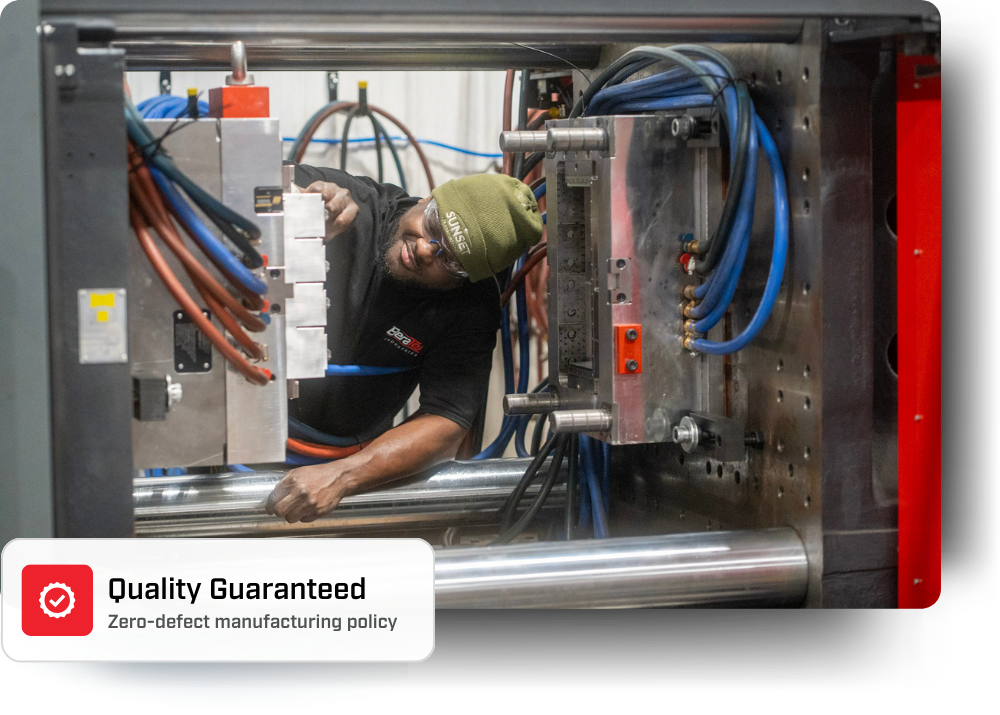
Why Companies Transfer Tooling
If you’re reading this, you’ve probably already decided something needs to change. Long lead times, missed deadlines, quality drift on parts that used to be fine, a supplier that takes a week to answer an email. The reasons companies move tooling are usually pretty consistent.

Reshoring from overseas
Tariffs, freight costs, and shipping delays have shifted the math. Production that made sense in China five years ago often doesn’t pencil out anymore once you add up the real total cost of ownership.

Unreliable current supplier
Missed delivery dates, communication gaps, parts that pass inspection sometimes and fail other times. When you can’t trust your supply chain, your customers can’t trust you.

Long, fragile supply chains
Single points of failure, six-week ocean freight, customs unpredictability. Reshoring shortens the line and gives you back control.

Acquisition or consolidation
You inherited tooling from another business unit or a recent acquisition and need a single domestic partner to run it.
Capacity issues
Your current molder can’t grow with you, or they’ve started deprioritizing your work in favor of larger accounts.
Quality concerns
Inconsistent shots, dimensional drift, rising scrap rates, or parts that no longer meet spec.
BeraTek’s Tool Transfer Process
Moving an injection mold is a meaningful investment, and we treat it that way. Every transfer follows the same disciplined process, with a single point of contact keeping you informed at each step.
01
Step 1
Initial Review
Before the mold ships, we review part drawings, prior shot samples, mold specs, processing parameters, and any history on issues you’ve experienced.
02
Step 2
Mold Capability Study
Full physical inspection on our floor. We check cavity, cooling, ejection, and runner condition, then document everything in a written report.
03
Step 3
Trials & Process Development
Mold runs under controlled conditions to establish a stable, repeatable process. Shot weight, fill speed, pack pressure, all locked in.
04
Step 4
Validation & First Article
Formal first article inspection, PPAP package if your industry requires it, or other qualification. Parts confirmed before production.
05
Step 5
Production
Tool runs in our facility on your schedule with the same vertically integrated support we give every project: engineering, quality, and a team that picks up the phone.
Getting Started
What We Need From You
To keep the transfer moving, the more you can send us up front, the better. Don’t worry if you’re missing some of these — especially on older tools or tools from suppliers that didn’t document much. We can work through it.
Part drawings & models
Current revision, STEP files preferred

Prior shot samples
If available, helps us baseline quality
Existing mold drawings
Or any tool specs you have on file
Known issues or history
Wear, repairs, or recurring problems

Processing parameters
Last known cycle, temps, and pressures

Quality documentation
Inspection criteria and tolerances

Production history
Annual volumes, cycle times, issues

Material specifications
Resin grade and approved sources
Frequently Asked Questions
Everything you need to know about our transfer tooling process.
Can you handle the logistics of shipping the mold?
We can coordinate logistics with you, including domestic freight and customs paperwork if the tool is coming from overseas. The actual shipment is usually handled by a specialized freight provider, but we can recommend ones we’ve worked with.
Do you handle tools from any country of origin?
Yes. We’ve worked on tools built in China, Mexico, Europe, and across the U.S. Quality and documentation vary widely by source, which is exactly why the capability study matters.
Will my parts be exactly the same as before?
In most cases, yes — that’s the goal of a clean transfer. Where we find issues that were affecting part quality at the previous molder, we’ll flag them and discuss whether to leave them alone or address them.
How long does a tool transfer take?
Most transfers move from initial review to validated production in 4–8 weeks, depending on mold complexity, the condition of the tool, and whether modifications are needed. We’ll give you a realistic timeline after the capability study.
Will my tool need to be modified?
Sometimes. Tools built for overseas presses occasionally need fitting adjustments. Tools that have been running for years may have wear that needs to be addressed. The capability study tells us exactly what’s needed, and we’ll walk you through options and cost before any work starts.
What if my tool isn’t worth transferring?
Occasionally we evaluate a tool and recommend rebuilding rather than refurbishing. We’ll tell you honestly. Our goal is to set you up for years of reliable production, not to sink money into a tool that won’t get you there.
Ready to start your
transfer tooling project?
Talk to our team and discuss your project – (844) 237-2835
From initial consultation to high-precision manufacturing, BeraTek is your engineering partner for success. Get a same-day quote for your project today.