








Questions to Ask Before You Sign with an Injection Molder
Choosing an injection molder is one of those decisions that looks simple on paper and gets expensive when you get it wrong. The quote is only one piece of the picture. The real cost of a molding partner shows up months later, in missed ship dates, surprise tooling fees, quality issues you find on your customer’s loading dock, and emails that go unanswered for a week.
The good news is that most of those problems are predictable. You just have to ask the right questions before you sign, not after. Here are the nine we’d want answered if we were sitting on your side of the table.
First, a Quick Reality Check on Quotes
Before we get into the questions, one thing worth saying up front: the lowest quote is rarely the lowest cost.
A quote tells you what a shop will charge to make your part. It doesn’t tell you how they’ll handle a resin shortage, what happens when your mold needs maintenance, or whether anyone will call you back when a run goes sideways. Two quotes that are $4,000 apart can easily be $40,000 apart over the life of a program once you factor in scrap, delays, and rework.
So treat the questions below as your real evaluation. The quote is just the starting point.
The 9 Questions That Separate Good Molders from Expensive Mistakes
A mold is a custom-built, precision-machined piece of tooling that your parts come out of, sometimes millions of times. Unlike the part itself, which is mostly just plastic and machine time, the mold carries all the engineering, machining, hardening, and fitting work up front.
That’s why two quotes for the same part can look so different. One shop might be pricing a basic aluminum tool for 10,000 parts. Another might be pricing a hardened steel tool built to run a million shots without touch-up. Same part. Very different tools.
1. Who actually owns my mold, and what’s in writing?
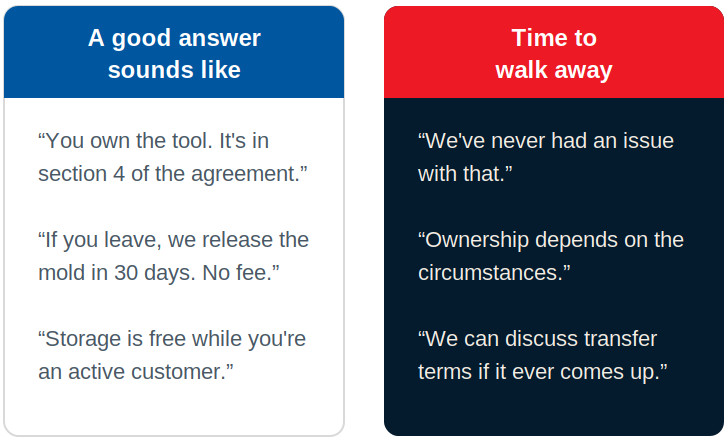
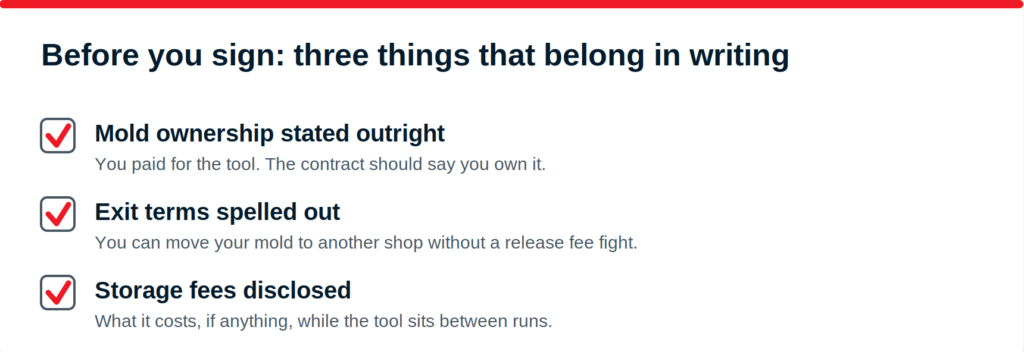
This should be a boring question with a boring answer: you paid for the tool, you own it, and it says so in the contract. If a molder hesitates here, that’s a problem.
Ask specifically:
- Is mold ownership spelled out in the quote or terms, not just implied?
- What happens if we part ways? Can you take your tool to another shop without a fight or a surprise release fee?
- Are there storage fees while the mold sits between runs?
A confident shop answers this in one sentence. A shop that plans to hold your tooling hostage answers it in a paragraph of qualifiers.
2. What are your real minimum order quantities?
Plenty of molders say they’re flexible, then quote you a 10,000-piece minimum that makes your pilot run impossible. If you’re launching a new product, validating a market, or running a low-volume industrial part, MOQs matter more than per-part price.
Ask what the smallest run they’ll actually schedule looks like, and whether small runs get treated like real jobs or like favors. At BeraTek, we run programs with no minimum order quantities, because a 500-piece run for a growing product line is exactly the kind of customer we want to grow with.
3. How will you handle my tooling, from build through end of life?
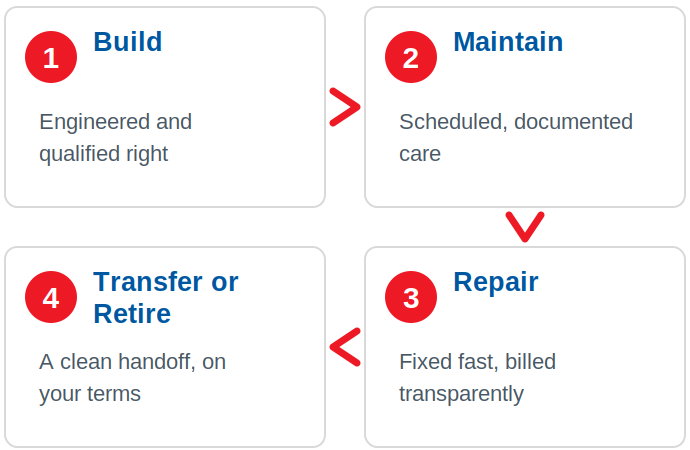
You’re not just buying parts. You’re entering a long-term relationship with a precision tool that needs to be built right, maintained, repaired, and eventually retired or transferred.
Ask:
- Who manages the tool build, and who’s your single point of contact if something needs to change?
- What does preventive maintenance look like? Is it scheduled, documented, and included, or does it only happen after a defect shows up?
- How are repairs handled and billed?
The answer you want is one team managing the whole tooling lifecycle, with one person you can call. The answer you don’t want is a shrug and “we’ll deal with it when it comes up.”
4. What happens if my parts fail inspection?
Every shop says they care about quality. The useful question is what happens when something goes wrong, because eventually something will.
Ask how defects are caught, documented, and resolved. Do they inspect in-process or only at the end? Will you get a corrective action report, or just a reshipment and a hope you don’t notice the pattern? A molder with a real quality system will walk you through their process without getting defensive. A molder without one will tell you they’ve “never had a problem.”
5. Can you support me on the engineering side, or just run the press?
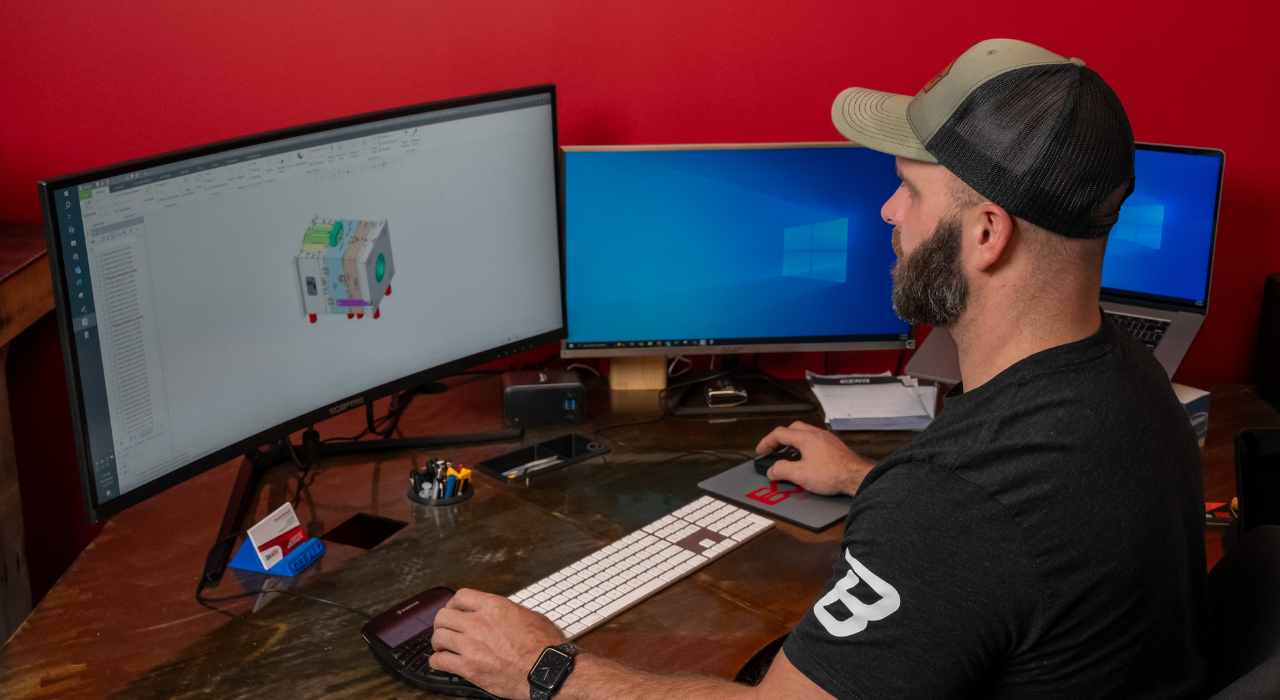
A part that’s hard to mold stays hard to mold for the life of the program. The cheapest fixes happen in design review, before the tool is ever cut.
“The most valuable thing a molder can tell you is what’s wrong with your part file. The least valuable thing is a quote on a design that was never going to mold well.”
Ask whether the shop offers design for manufacturability feedback, resin selection guidance, and prototyping support, or whether they expect a finished file and quote exactly what you send. A molder with engineering support on staff catches the thin wall, the missing draft, and the unnecessary undercut before those problems get machined into steel.
6. What resins do you run, and how do you handle material selection?
If your part needs glass-filled nylon, a food-grade resin, or anything beyond commodity plastics, you want a shop that’s run that material before, not one learning on your dime.
Ask what materials they run regularly, how they source resin during shortages, and whether they’ll help you pick the right material rather than just the one you guessed at. The wrong resin choice can quietly double your part cost or sink your product in the field.
7. What are your lead times, and what’s your track record on hitting them?
Everyone quotes a lead time. Fewer shops hit it consistently.
Ask:
- What’s the current lead time for tooling and for production runs?
- How do you communicate delays? Proactively, or only when you call asking where your parts are?
- What does your scheduling look like when a rush job comes in? Do existing customers get bumped?
You’re not just buying parts on a date. You’re buying predictability for your own customers downstream.
8. Can you take on a transferred mold from another shop?
This one matters even if you’re starting a brand-new program, because it tells you how the relationship ends if it has to. A shop that regularly takes in transfer tooling understands mold evaluation, sampling, and qualification, and that same discipline shows up in how they treat your tool day to day.
And if you’re reading this because your current molder is the problem, ask directly: what does your transfer process look like, and how do you avoid a production gap while the tool moves?
9. Who will I actually talk to once the contract is signed?
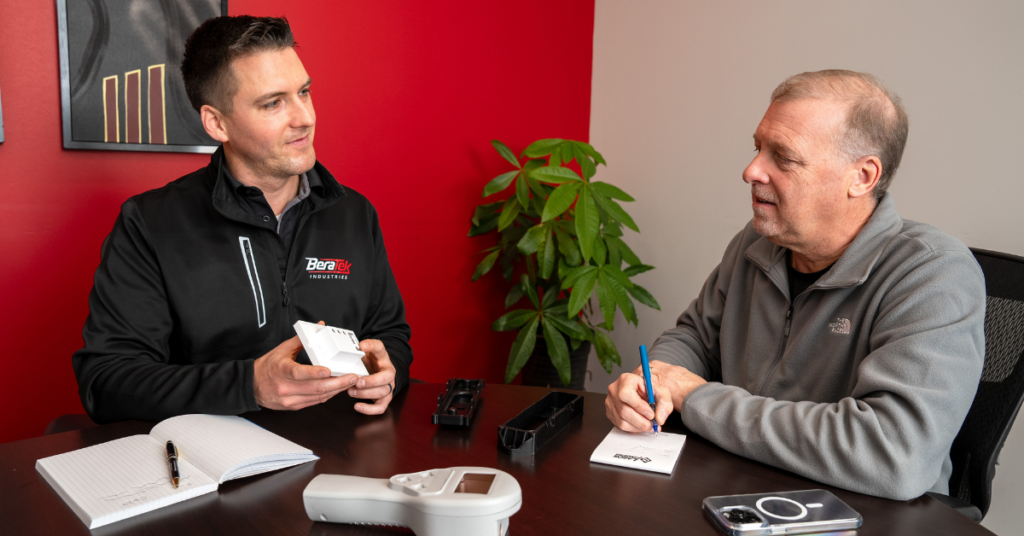
The salesperson who quoted your job is probably not the person running it. Ask who your day-to-day contact will be, how quickly they respond, and whether you can talk to them before you sign.
This sounds soft compared to tooling specs and quality systems, but communication failures cause more program pain than press failures do. One team, one point of contact, and a person who answers the phone will save you more headaches than any line item on the quote.
Red Flags Worth Walking Away From
A quick gut-check list. Be cautious with any molder who:
- Won’t put mold ownership in writing
- Quotes fast but can’t explain what’s driving the price
- Has no documented quality or maintenance process
- Gets vague when you ask about small runs or transferred tooling
- Can’t tell you who your contact will be after the sale
None of these is automatically a dealbreaker on its own. Two or more together usually is.th a vertically integrated shop that handles design, engineering, and tooling under one roof almost always saves money. Problems get caught in the design review, not on the shop floor.
The Bottom Line
Picking an injection molder isn’t really a purchasing decision. It’s a partnership decision dressed up as one. The right shop protects your tooling, catches design problems early, tells you the truth about lead times, and picks up the phone when something changes. Ask these nine questions of every molder you’re considering. The shops worth working with will appreciate that you asked. The ones that get cagey just saved you a very expensive lesson.
Ready to put us on the spot?
Ask BeraTek every question on this list. Our team manages design support, tooling, and production with one point of contact from quote to shipment, no minimum order quantities, and straight answers from the first conversation. Request a quote or contact us to talk through your project.